
Data Analytics Guide

Prashanth Tunniki, Learn Skills, Unlock Opportunities

Why Data Analytics?

Data analytics is crucial because it helps businesses and organizations make data-driven decisions, optimize processes, improve efficiency, and gain a competitive edge. It turns raw data into actionable insights, reducing risks and enhancing decision-making.

Importance of Data Analytics

  1. Better Decision-Making – Helps businesses and individuals make informed choices based on data trends.
  2. Cost Reduction – Identifies inefficiencies and helps in cost-saving strategies.
  3. Improved Customer Experience – Personalizes services and enhances customer satisfaction.
  4. Fraud Detection – Identifies suspicious patterns to prevent fraud.
  5. Business Growth – Helps companies understand market trends and consumer behavior.
  6. Operational Efficiency – Streamlines operations by analyzing performance data.

Where Do We Use Data Analytics?

Data analytics is used across various industries, including:

  • Business & Marketing: Predicting customer behavior, sales forecasting, and improving marketing strategies.
  • Healthcare: Diagnosing diseases, optimizing hospital operations, and medical research.
  • Finance & Banking: Fraud detection, risk assessment, and algorithmic trading.
  • Retail & E-commerce: Customer segmentation, demand forecasting, and inventory management.
  • Manufacturing: Process optimization, predictive maintenance, and supply chain management.
  • Sports: Player performance analysis, team strategy, and injury prevention.
  • Education: Personalized learning experiences and student performance tracking.

- If you try to catch a cat, it will run away.

 However, If you have what the cat wants, it will come to you.

data science is available.

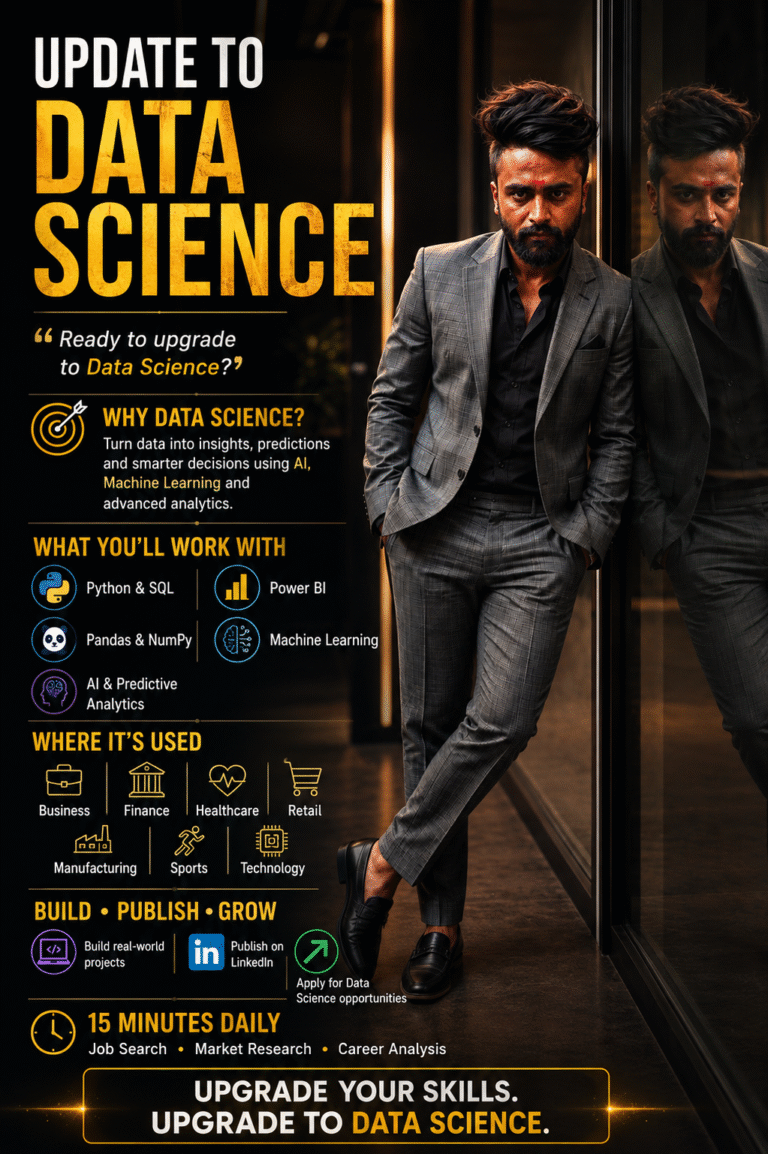
  "Ready to upgrade to Data Science........."

    "Explore the possibilities: Upgrade to Data Science."

Why Data Science ?

Data science is essential because it helps extract meaningful insights from large and complex datasets using advanced techniques like machine learning, artificial intelligence, and statistical analysis. It enables businesses and organizations to solve problems, predict outcomes, and automate decision-making processes.


Importance of Data Science

  1. Data-Driven Decisions – Helps organizations make informed choices based on data.
  2. Predictive Analytics – Forecasts trends, customer behavior, and market changes.
  3. Automation – Uses AI and machine learning to automate tasks and improve efficiency.
  4. Personalization – Enhances customer experience through targeted recommendations.
  5. Fraud Detection & Security – Identifies anomalies to prevent fraud and cyber threats.
  6. Scientific Research – Drives innovation in fields like medicine, climate science, and space exploration.

Where Do We Use Data Science?

Data science is widely used across industries, such as:

  • Business & Marketing: Customer segmentation, recommendation systems, and demand forecasting.
  • Healthcare: Disease prediction, drug discovery, and medical image analysis.
  • Finance & Banking: Credit scoring, fraud detection, and algorithmic trading.
  • Retail & E-commerce: Personalized shopping experiences, inventory optimization, and dynamic pricing.
  • Manufacturing: Predictive maintenance, quality control, and supply chain optimization.
  • Sports Analytics: Performance tracking, injury prediction, and game strategy optimization.
  • Education: Adaptive learning, student performance analysis, and AI-driven tutoring.
  • Government & Security: National security analysis, crime prediction, and smart city planning.
Prashanth Tunniki UPGRADE YOUR SKILLS. UPGRADE TO DATA SCIENCE.

📌 2-Month Action Plan Services…….

🎯 Goal: Secure Interview Appointments & Land a Job

Approach: Consistent job applications + networking + skill improvement.


📅 Month 1: Build Momentum & Optimize Applications

📌 Week 1: Profile Optimization & Application Setup

✅ Update & optimize LinkedIn, Naukri, Indeed, and other job portals.
✅ Ensure resume & LinkedIn are ATS-friendly (use industry keywords).
✅ Apply for 5-10 jobs per day on various portals.
✅ Identify 50+ recruiters & hiring managers on LinkedIn and send connection requests.
✅ Engage with 5+ LinkedIn recruiter posts daily (comment & like).
✅ Start cold DMs & emails to recruiters (target 3-5 per day).
✅ Join relevant LinkedIn, Telegram, WhatsApp job groups.


📌 Week 2: Job Applications & Recruiter Outreach

✅ Continue applying to 5-10 jobs daily.
✅ Send follow-up emails to recruiters after 3-5 days of application.
✅ Increase LinkedIn engagement – post at least 1 update per week.
✅ Attend at least 2 virtual networking events or webinars.
✅ Improve skill set (if required) – brush up on Power BI, SQL, Python.

📌 Week 3: First Round of Follow-ups & Direct Applications

✅ Follow up on all pending applications (personalized follow-ups).
✅ Cold DM at least 10 new recruiters this week.
✅ Apply to 10-15 jobs in new industries/companies.
✅ Start participating in mock interviews for better preparation.
✅ Ask for referrals from previous colleagues or LinkedIn connections.

📌 Week 4: Interview Preparation & Skill Reinforcement

✅ Review common interview questions & prepare answers.
✅ Conduct at least 2-3 mock interviews.
✅ Start tracking recruiter responses & interview calls in a spreadsheet.
✅ Expand job search to startups, mid-sized companies, and MNCs.
✅ Continue LinkedIn engagement – post a job search update.

ontinue LinkedIn engagement – post a job search update.


📅 Month 2: Focus on Interviews & Converting Opportunities

📌 Week 5: Interview Rounds & Targeted Applications

✅ Start receiving interview calls – schedule & attend them.
✅ Prepare STAR-method answers (Situation, Task, Action, Result) for behavioral questions.
✅ Apply to higher-quality roles (focus on senior recruiters & hiring managers).
✅ Continue cold DMs & direct outreach.


📌 Week 6: Refine Job Search Strategy & Expand Networking

✅ Analyze which types of applications & messages are working best.
✅ Expand to international job portals (if applicable).
✅ Send 2nd follow-ups to recruiters if no response yet.
✅ Continue LinkedIn engagement & attending networking events.

📌 Week 7: Multiple Interview Rounds & Negotiation Prep

✅ Attend final interview rounds & start preparing for salary negotiation.
✅ Check for referrals within target companies.
✅ Continue applying to 5-7 high-value roles daily.
✅ Engage in HR & recruiter LinkedIn discussions.

📌 Week 8: Final Push & Offer Negotiation

✅ Evaluate multiple offers (if available) & negotiate salary.
✅ Send thank-you emails post-interviews.
✅ Ensure job confirmation in writing.
✅ Plan onboarding (if hired) or continue applying if needed.


🎯 Key Metrics for Success

Jobs Applied: 150+ applications
Recruiter DMs Sent: 60+
Follow-ups Sent: 50+
Networking Events Attended: 6+
Interview Calls Received: 5-10
Job Offers Secured: 1+

🔥 Final Notes for Success

🔹 Consistency is key – daily applications & follow-ups are necessary.
🔹 Personalized outreach gets better responses than mass applications.
🔹 Interview prep & negotiation skills will ensure a great job offer.
🔹 Tracking progress will help improve strategy over time.

🚀 By following this plan, You sshould land interviews & secure a job offer within 2 months!

Let me know if any tweaks are needed! 😊

An upgrade to data science is available.

COMING SOON

COMING SOON

COMING SOON

COMING SOON

COMING SOON

COMING SOON

COMING SOON

COMING SOON

COMING SOON

COMING SOON

COMING SOON

COMING SOON

– “If you try to catch a cat, it will run away. However, If you have what the cat wants, it will come to you.”

Scroll to Top